Carved Mirror Frame: What the Ragnarök Frame Shows
A carved mirror frame can tell a whole story around its glass, and the Ragnarök Frame by wood sculptor Oleg Peresvet tells the end of the Norse world: the wolf Fenrir with the sun, the World Serpent Jörmungandr, and warriors in the last battle. The scenes come from Norse myths preserved in 13th-century Icelandic manuscripts.
The Ragnarök Frame in iroko
The frame is carved in iroko, and its scenes stand out in high relief. It shows Ragnarök, the battle at the end of the Norse world, and is sized for a large mirror or artwork.
Along the upper rail lies Jörmungandr, the World Serpent. On the frame, the wolf Fenrir has the sun in his jaws, and at the bottom, warriors with round shields meet in battle. Celtic interlace runs between these scenes.
In the photos, the frame hangs on a rough stone wall in bright sunlight. One close-up shows a bearded warrior in a winged helmet and a coat of mail at the front of the fight, with more fighters and shields crowded behind him.
The winged helmet comes from a later image of the Vikings. No Viking Age helmet with horns or wings has been found, and the few helmets from that time look more like the older helmets of the Vendel period. The idea took hold in the 19th century, helped by costumes for Richard Wagner’s operas.
Ragnarök in the Norse myths
The main accounts of Ragnarök are the poems Völuspá and Vafþrúðnismál in the Poetic Edda and the Gylfaginning section of Snorri Sturluson’s Prose Edda, all written down in 13th-century Iceland. The name is often explained as “the final destiny of the gods.” The form “twilight of the gods” became famous through Wagner’s opera Götterdämmerung of 1876.
The story of Ragnarök begins with Fimbulwinter, a long winter that lasts three years with no summer in between. Two wolves catch the sun and the moon, the earth shakes, Fenrir breaks free, and Jörmungandr rises from the sea. Then the gods and their enemies meet in a battle in which many of them die.
Fenrir swallows Odin, and Odin’s son Víðarr avenges his father by forcing the wolf’s jaws apart. Thor kills Jörmungandr, and Heimdallr and Loki kill each other. In the end, the fire giant Surtr sets the whole world on fire.
Ragnarök is not the last word in the myth. The earth rises again from the sea, green and fertile, Víðarr and Váli survive, and Baldr returns from the realm of the dead. Two humans, Líf and Lífþrasir, survive to fill the new world with people.
Fenrir, the wolf and the sun
Fenrir is a son of the god Loki and the giantess Angrboða, and his brother and sister are Jörmungandr and Hel. Because of prophecies that he would bring great harm, the gods bound him with a magic fetter made by dwarves, which grew stronger the harder the wolf pulled against it. Britannica lists some of the things it was made of, among them a cat’s footfall, a woman’s beard, and a fish’s breath.
The god Týr put his hand in the wolf’s mouth as a pledge, and when the gods would not let Fenrir go, the wolf bit it off. According to one version of the myth, Fenrir himself will swallow the sun at Ragnarök. In other accounts, the sun is swallowed by the wolf Sköll, one of Fenrir’s sons, while his brother Hati swallows the moon.
Jörmungandr and Thor
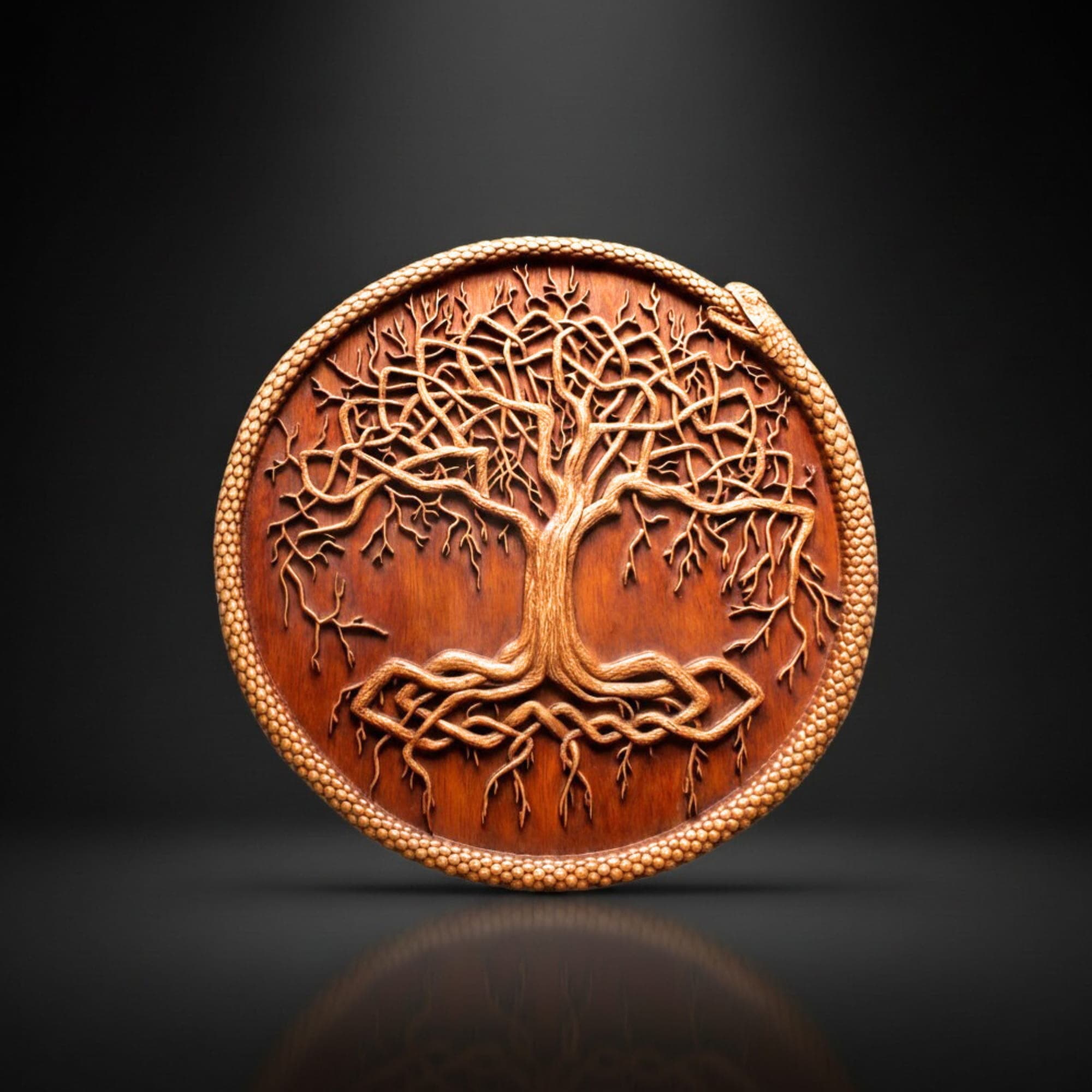
Jörmungandr is so large that he lies around the whole earth and holds his own tail in his mouth. At Ragnarök, he lets go and rises against the gods. Thor kills him in the last battle, but the venom reaches him, and he manages only nine steps before he dies.
Thor had met the serpent once before, on a fishing trip when he hooked it from a boat, and that scene was a popular subject in Norse art. It is carved on several picture stones, among them the Altuna Runestone in Sweden and a stone slab at Gosforth in England. On Oleg Peresvet’s Norse Mythology Frame, also carved in iroko, the serpent’s body loops through Celtic knotwork, and Thor drives a chariot pulled by goats.
Ragnarök in stone
Carvers have shown these scenes for more than a thousand years. Thorwald’s Cross on the Isle of Man shows a man holding a spear, with one foot in a wolf’s mouth, a scene read as Odin swallowed by Fenrir. On the Gosforth Cross in Cumbria, England, carved between 920 and 950, a man with a spear faces a monster’s head, a scene read as Víðarr fighting Fenrir. The Ledberg stone in Sweden is also read as showing the wolf and Odin at Ragnarök.
Carved picture and mirror frames, then and now
The earliest picture frames are thought to be those around some Fayum mummy portraits from Roman Egypt. Carved wooden frames first appear on small panel paintings of 12th- and 13th-century Europe, where panel and raised border were cut from one piece of wood. Gentile da Fabriano’s Adoration of the Magi of 1423 is considered the first altarpiece whose frame was made separately from the panel.
In France under Louis XIII, who reigned from 1610 to 1643, frame profiles became thinner than their Italian models, and continuous ornament such as egg-and-dart appeared. A frame protects what it holds and separates it from the wall around it.
The Ragnarök Frame and the Norse Mythology Frame belong to Oleg Peresvet’s carved mirror and picture frames. Every frame is sized to the piece it will hold and carved from solid hardwood; the frames in the collection are walnut or iroko, and they range from a view of Palma de Mallorca to a wolf family in a mountain landscape. For a bespoke commission, the client can choose the wood, such as walnut, oak, or iroko.
“For me, a frame is never just a border. It tells its own story around what it holds.”
FAQ
What is a carved mirror frame?
A carved mirror frame is a wooden frame with ornament or scenes cut into its surface, made to hold a mirror. Oleg Peresvet’s frames are carved from solid hardwood to fit the piece they hold, whether that is a mirror, a painting, or a print.
What is Ragnarök?
Ragnarök is the foretold end of the world in Norse mythology, with a great battle in which many gods die. After it, the earth rises again, green and fertile.
Does Fenrir swallow the sun?
According to one version of the myth, Fenrir will swallow the sun. In other accounts, it is his son Sköll who swallows the sun.
Did Vikings wear winged helmets?
No helmet with horns or wings is known from the Viking Age. The image became popular in the 19th century, helped by costumes for Richard Wagner’s operas.
What wood is the Ragnarök Frame made of?
The Ragnarök Frame is made of iroko. Other frames in the collection, such as the Palma de Mallorca Mirror Frame, are carved in walnut.
To talk about a carved frame for your own mirror or artwork, get in touch with Oleg Peresvet.
See the collectionCarved Frames →