Norse Symbols and Their Meaning: Yggdrasil, Vegvísir, and Triple Fehu
The meaning of Norse symbols depends on where each one comes from: Yggdrasil is the world tree that links the nine worlds of Norse mythology, the Fehu rune stands for cattle and wealth, and the Vegvísir is an Icelandic sign meant to keep a traveler from losing the way. Three carved pieces by wood sculptor Oleg Peresvet, all in iroko, show these signs together with a serpent, a triquetra, and the Helm of Awe.
Where Norse symbols come from
Not all Norse symbols are equally old. Yggdrasil is known from two Icelandic collections, the Poetic Edda and the Prose Edda, both compiled in the 13th century. Runes are older: the Elder Futhark, the oldest runic alphabet, has 24 runes in three groups of eight and is found in inscriptions from the 2nd to the 8th centuries.
Other signs are much younger. The Vegvísir is first recorded in an Icelandic manuscript from 1860, and there is no record of it from the Viking Age. Below, the meaning of Norse symbols is given together with the source of each one.
Yggdrasil: the world tree
In Norse mythology, Yggdrasil is a giant ash tree at the center of the cosmos. The Britannica entry on Yggdrasill describes it as the world tree that supports the universe and links the nine worlds, among them Asgard, the realm of the gods; Midgard, the earth; and Niflheim, the underworld. In the myths, it stands for both life and death, and new life is said to come from it after Ragnarök.
The tree also has a place in the story of Odin. In the poem Hávamál, Odin hangs himself from a tree to gain knowledge, and scholars connect this with the name Yggdrasil, often read as “Odin’s horse,” a poetic term for the gallows. When Ragnarök comes, the Eddas say that Yggdrasil shivers where it stands.
The Eddas give the tree three roots, each reaching a well or a spring. An eagle sits in its branches, the dragon Níðhöggr gnaws at its roots, the squirrel Ratatoskr carries messages, and four stags feed on its leaves. The three Norns, who live by the well Urðarbrunnr, care for the tree, and the gods meet at the tree every day to hold their assemblies.
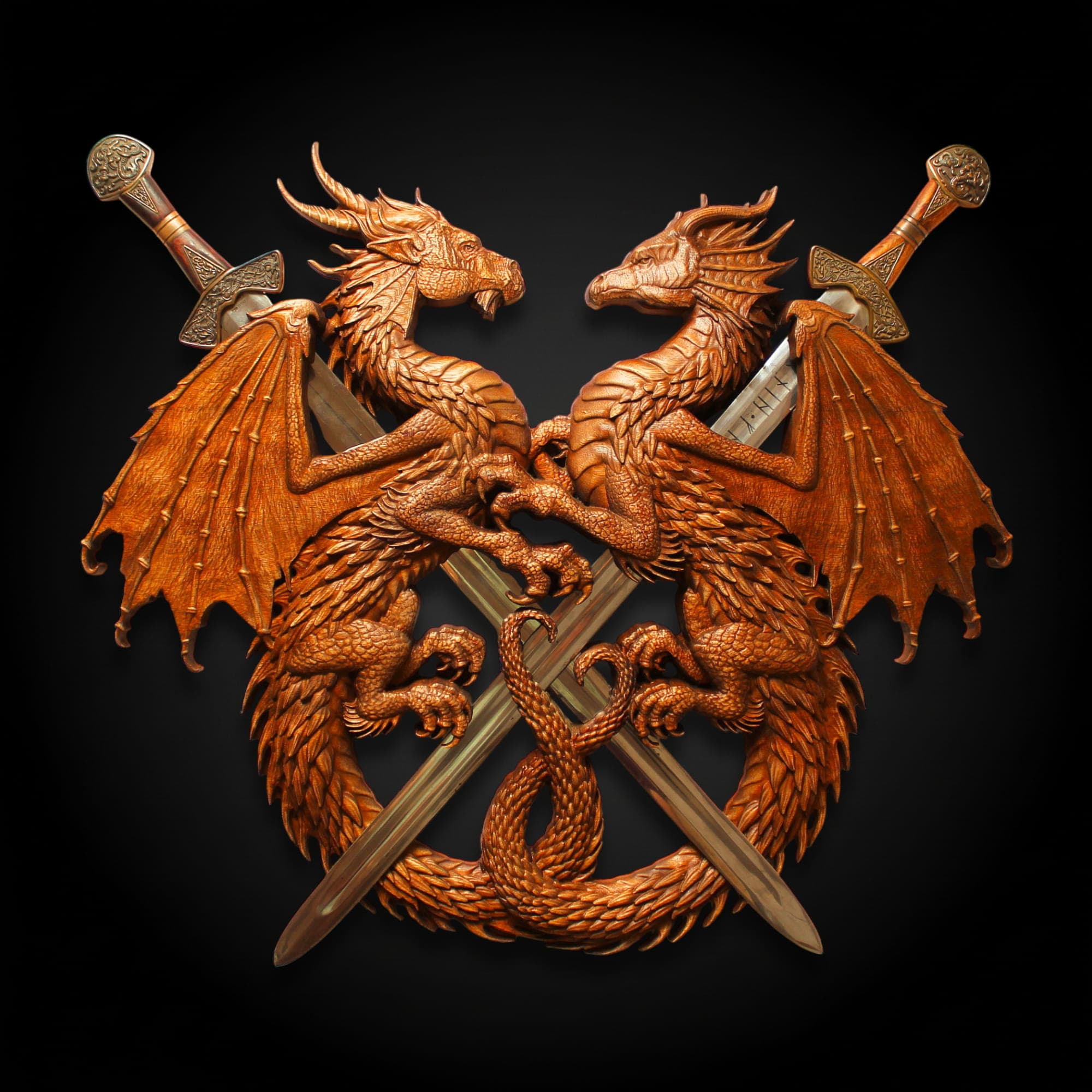
Oleg Peresvet’s Yggdrasil — Tree of Life is a round piece of Yggdrasil wall art in solid iroko. Branches and roots are carved as two matching halves, with the crown at the top and the roots at the bottom, where they weave into each other. A carved serpent circles the whole border.
The serpent on the border is an ouroboros, a snake that eats its own tail, and its Greek name means “tail-eating.” The symbol is much older than the Norse myths: one of the earliest known examples is in an Egyptian funerary text from the tomb of Tutankhamun, from the 14th century BCE. Norse mythology has its own version in Jörmungandr, the World Serpent, who encircles Midgard and grasps his own tail. His release of the tail is one of the signs that Ragnarök has begun.
The Fehu rune and the triple Fehu
Fehu is the first rune in all the futharks, the runic alphabets, from the Elder Futhark to the Younger Futhark of the Viking Age. Its reconstructed Proto-Germanic name, *fehu, means livestock or cattle, and by extension wealth. In Old English, the rune is called Feoh, and in Old Norse it is Fé.
The old rune poems do not describe wealth only as a blessing. The Old English poem calls wealth a comfort to everyone but says that each person must give it away freely, while the Old Norse poems say that it causes strife among kin.
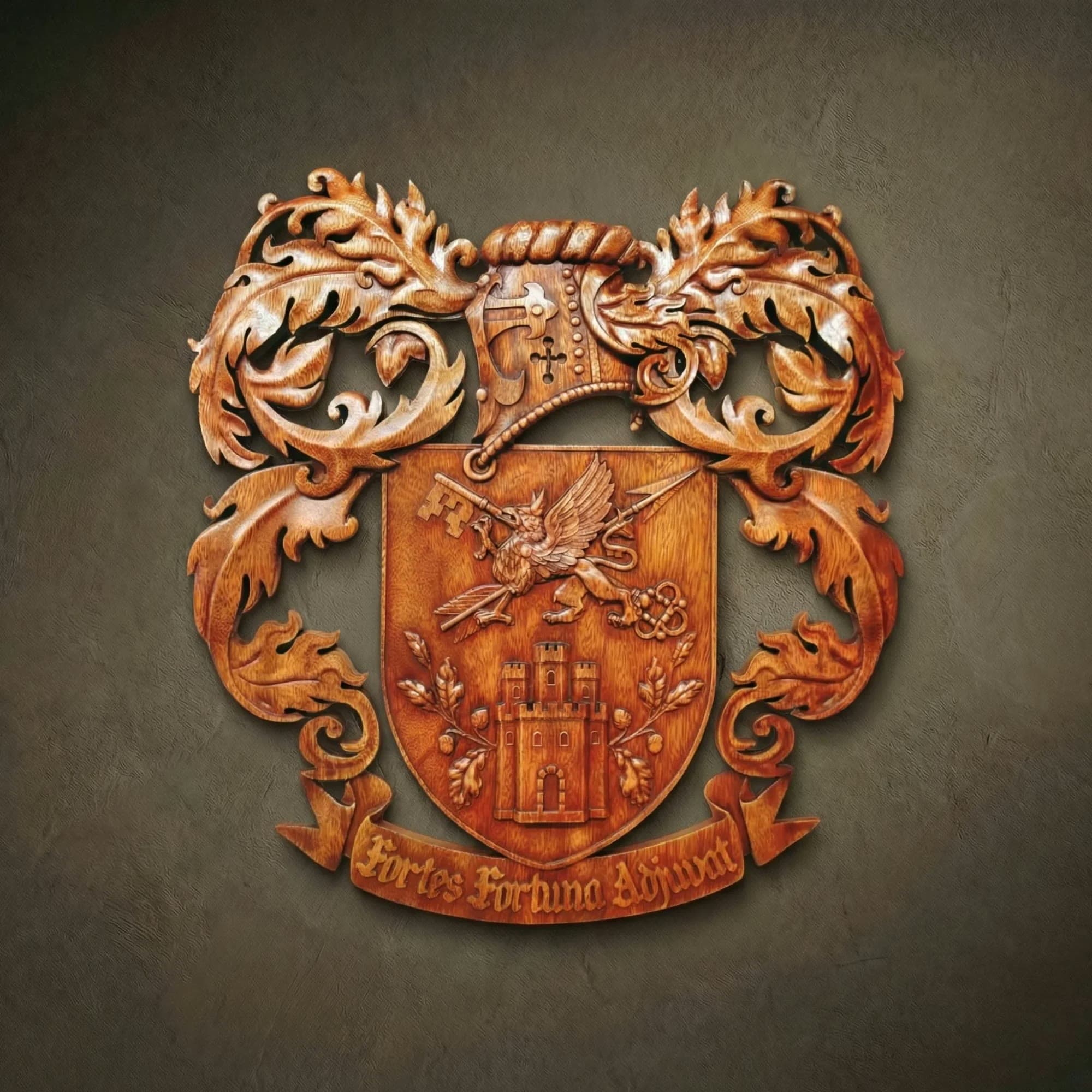
The Norse Rune Shield by Oleg Peresvet is built around the triple Fehu. The three runes stand out in relief over the crown of the tree, and its roots fill the lower part of the shield. Above the runes sits a triquetra knot, the two upper corners end in dragon heads, and Celtic interlace forms the edge.
The triquetra is made of three interlaced arcs, and its name comes from the Latin word for three-cornered. It appears on runestones, on Norwegian pennies from the reign of Harald Hardrada (1047–1066), and in Insular art such as the Book of Kells. Its original meaning is unknown, and its reading as a symbol of the Christian Trinity came later.
Vegvísir and the Helm of Awe
The name Vegvísir means wayfinder, from the Icelandic words for way and for showing or guiding. The sign is recorded in the Huld Manuscript, compiled by Geir Vigfússon in Akureyri, Iceland, in 1860. According to the manuscript, whoever carries the sign will never lose their way in storms or bad weather.
The Vegvísir is often called a Viking compass, but no record of it older than this manuscript has been found. The Helm of Awe, Ægishjálmur in Icelandic, is an older name: in the Poetic Edda and Völsunga saga, it is a helmet from the hoard of the dragon Fáfnir, which all living creatures feared. It later became a magical stave in Icelandic folk tradition.
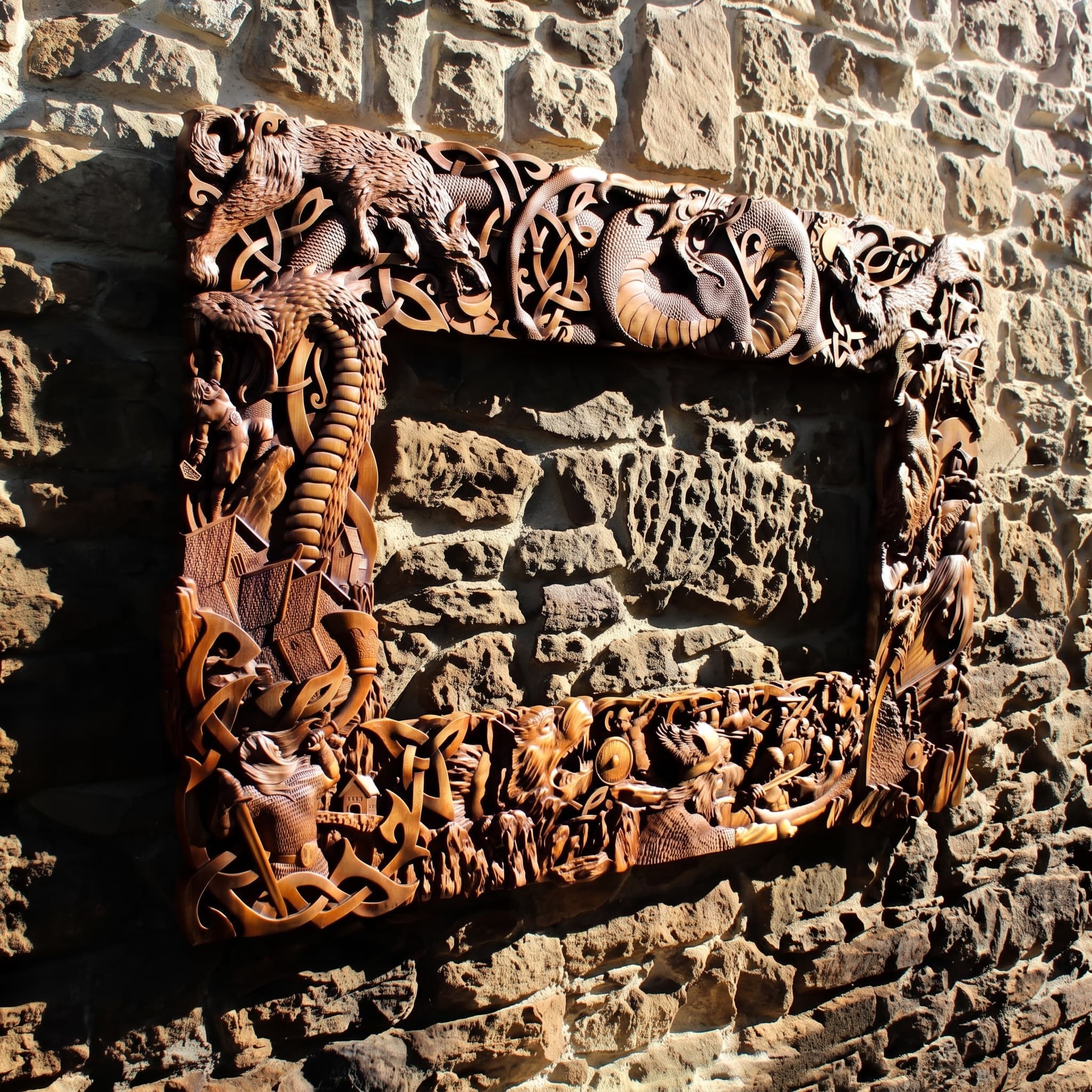
Both signs appear on the Ethereal Wolf Mirror Frame by Oleg Peresvet. Knotwork runs around the iroko frame, and on the lower rail, wolves move through a mountain scene. Each corner has its own medallion:
- a wolf’s head
- the Vegvísir
- the Helm of Awe
- a triquetra
Norse symbols as wall decor
The Yggdrasil roundel and the Norse Rune Shield belong to Oleg Peresvet’s carved wall art, a collection of Viking wall art and Norse wall decor in iroko that also includes a fleet of Viking drakkars, three ravens in a triskelion, and two sword stands. The Ethereal Wolf frame is one of his carved mirror and picture frames, next to the Ragnarök Frame, where Fenrir swallows the sun and Jörmungandr lies along the upper edge.
“I never carve a symbol only as decoration. Its meaning has to stay in the wood.”
FAQ
What does Yggdrasil symbolize?
In Norse mythology, Yggdrasil is the world tree, a giant ash that links the nine worlds. It stands for both life and death, and new life is said to come from it after Ragnarök.
Is the Vegvísir a Viking symbol?
There is no record of the Vegvísir from the Viking Age. Its earliest known record is the Huld Manuscript, compiled in Iceland in 1860.
What does the Fehu rune mean?
Fehu is the first rune in the futharks, the runic alphabets. Its name means cattle or livestock, and by extension wealth. The old rune poems link it with both comfort and strife among kin.
What is the Helm of Awe?
The Helm of Awe, or Ægishjálmur, is a helmet from the dragon Fáfnir’s hoard in the Poetic Edda and Völsunga saga. It later became a magical stave in Icelandic folk tradition.
What does the triquetra mean among Norse symbols?
The original meaning of the triquetra is unknown. It appears on runestones and on Norwegian coins of the 11th century, and it was later read as a symbol of the Christian Trinity.
To talk about a piece with Norse symbols for your own space, get in touch with Oleg Peresvet.
See the collectionCarved Wall Art →