Viking Sword Wall Mount: Dragons and Celtic Knots in Carved Wood
A Viking sword wall mount by wood sculptor Oleg Peresvet holds the sword inside a carved piece of wall art: one stand frames two swords with a pair of dragons, and the other wraps a single sword in Celtic knotwork. Both motifs have deep roots in early medieval art from Scandinavia and the British Isles.
Two carved sword stands in iroko
The Dragon Sword Stand is made to hold a pair of decorative swords on the wall. Two dragons face each other with their wings spread, and their tails twist together into a loop at the bottom. The swords cross behind them, with the hilts at the top.
The dragons are cut deep into the wood. The photos show every scale, horn, and rib of the wings in detail.
The Celtic Sword Stand holds a single sword upright. A long knot of interlace winds around the blade in one continuous line, and two tall, curved horns stand on either side. According to the atelier, it is made for replica medieval weapons, so that they can become part of the interior. Both stands are made of iroko.
Swords in the Viking Age
Viking swords were made from the 8th to the 11th century. They developed from the earlier Merovingian swords, and in the 11th and 12th centuries, they led to the knightly sword of the Romanesque period. Most had a double-edged blade of about 70 to 90 centimeters, and a complete sword usually weighed around 1 to 1.5 kilograms.
The sword was carried in a scabbard of wood and leather with metal fittings, which hung from a sword belt. Researchers still sort Viking swords by the hilt types that Jan Petersen published in 1919, based on about 1,700 finds from Norway.
Swords cost a lot to make, and owning one showed a person’s standing. They were often passed down from one generation to the next and given their own names, such as “Leg-biter.” In the Laxdæla saga, one sword is valued at half a crown, the worth of 16 milk cows.
Some of the finest blades carry the inlaid name Ulfberht, and after about 1000, better swords were more and more often made of crucible steel. Hilts decorated with precious metals were common in the 8th and 9th centuries, but this custom faded during the 10th century. Many pommels were divided into three or five rounded lobes, a Frankish design. The Swedish History Museum shows one such prestigious sword, found in a grave at Linga in Södermanland, with gilded brass panels on its hilt and a silver plate on the pommel.
Dragons in Viking art and legend
Dragons appear again and again in Viking art and legend. The largest longships were called dragons, dreki in Old Norse, and some had a carved dragon head at the bow and a tail at the stern. The Vikings’ enemies, among them the English, called these vessels dragonships. The historian Judith Jesch links the name to the carved heads but finds no evidence that dreki meant one particular type of ship.
In Norse legend, the dragon Fáfnir guards a hoard of gold until the hero Sigurd kills him. The Ramsund carving in Södermanland, Sweden, cut into a flat rock around the year 1030, shows several scenes from this story. Among them are Sigurd killing Fáfnir, his horse Grani loaded with the dragon’s treasure, and the smith Regin lying dead beside the tools he had used to remake Gram, Sigurd’s sword.
The Ramsund carving belongs to a group known as the Sigurd stones, the earliest Norse pictures of this legend, with examples in Sweden, northern England, and the Isle of Man. Some of them combine Sigurd scenes with crosses, which shows that the old legend was still used as Norse paganism gave way to Christianity.
Celtic knots and Norse interlace
Interlace is decoration made of bands that pass over and under each other to form a pattern. The knotted kind, in which bands are cut and rejoined, first appeared in northern Italy and southern Gaul, and by the 7th century, it was used in Ireland. The oldest known Celtic-style knots are in a 7th-century Gospel fragment from northern Britain, now at Durham Cathedral.
Knotwork became a mark of Insular art, the art of Britain and Ireland in the early Middle Ages. It fills whole pages in the Lindisfarne Gospels and decorates almost every page of the Book of Kells. Irish metalwork such as the Cross of Cong combines animal ornament with ribbon knots. After about 700, interlace faded in most of Europe, but it stayed in use in the British Isles and in Scandinavia until the 12th century.
Germanic art had its own kind of interlace, with ribbons that end in the head of an animal, as on finds from Sutton Hoo in England from the mid-7th century. The scholar J. Romilly Allen traced most Celtic knotwork back to just eight basic knots.
In Scandinavia, the last phase of animal art is called the Urnes style, after the carved north door of the Urnes stave church in Norway. Some scholars prefer the name Runestone style, since most pieces in this style are runestones in Uppland, Sweden. It was used from about 1050 into the early 1100s, with thin animals that twist through each other in tight loops, and it also appears on coins of Harald Hardrada, who ruled Norway from 1047 to 1066.
Sword stands among Oleg Peresvet’s wall art
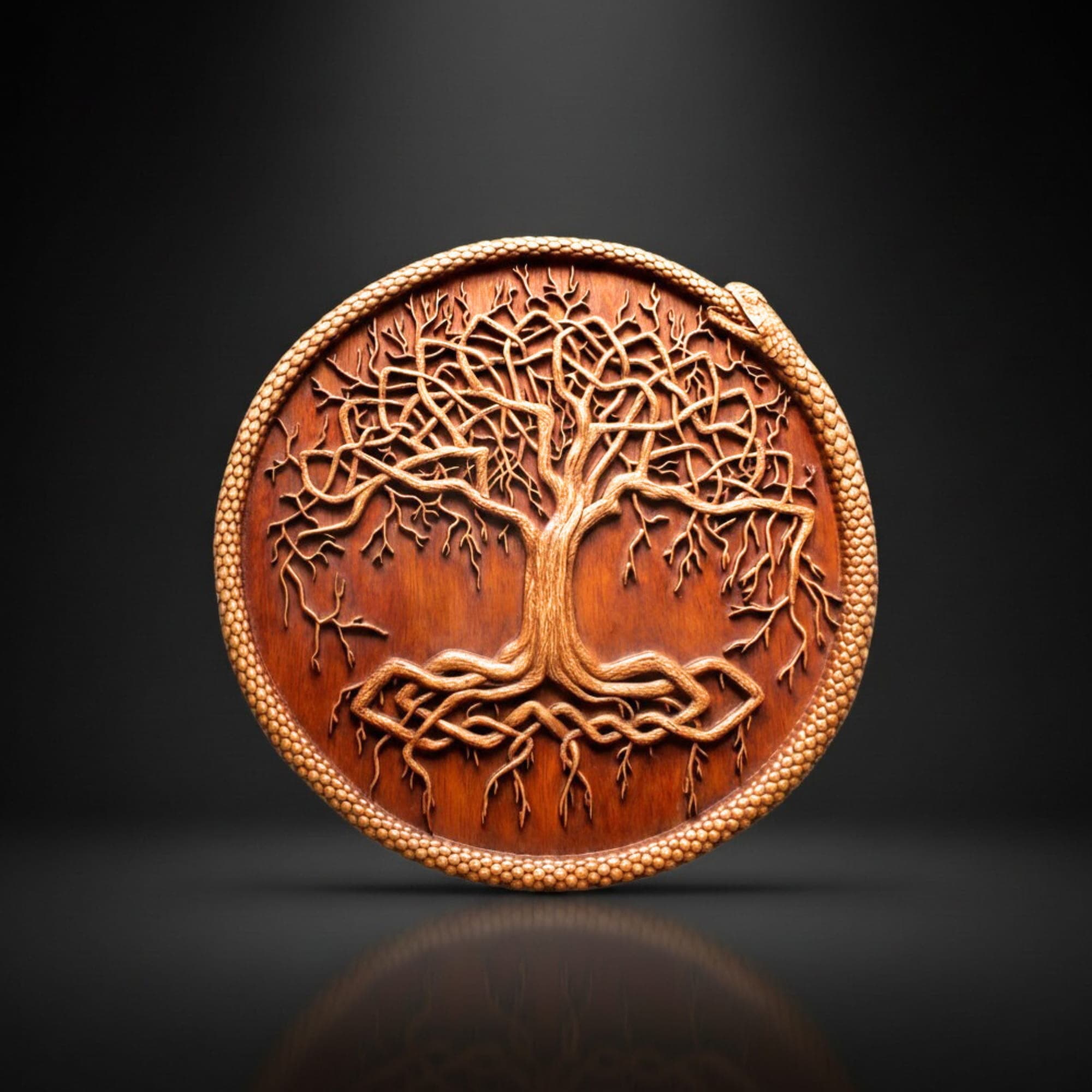
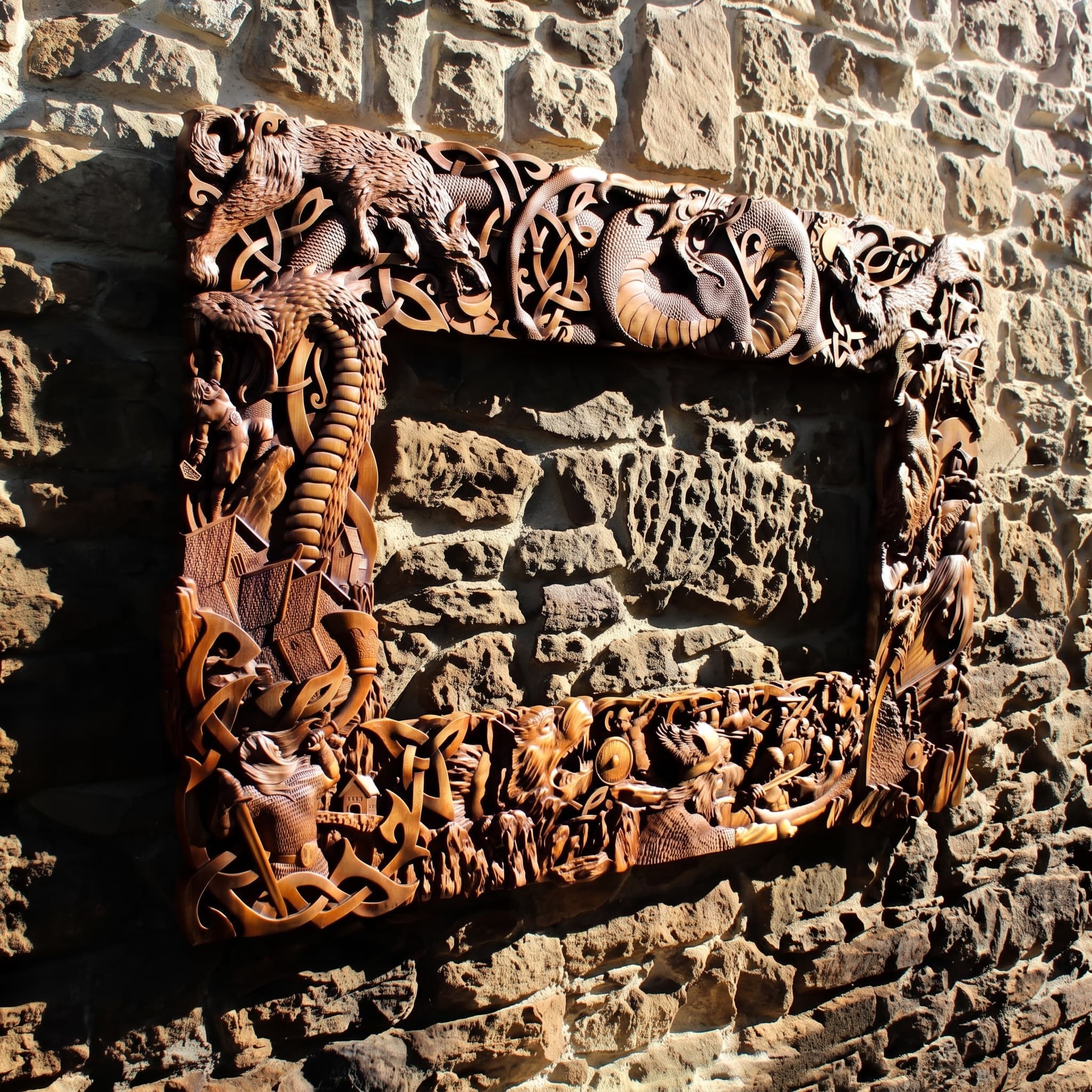
The two stands belong to Oleg Peresvet’s carved wall art, next to the Viking Fleet relief, the Three Ravens Triskelion, the Yggdrasil roundel, and the Norse Rune Shield. All of these pieces are made of iroko.
For bespoke commissions, the client brings an idea, and the atelier settles the design in sketches and 3D renders before any wood is cut. The client can choose walnut, oak, iroko, or another wood.
“For me, a sword stand is never just a holder. It is part of the wall it hangs on.”
FAQ
What is a Viking sword wall mount?
A Viking sword wall mount is a stand fixed to the wall that holds one or more swords on display. Oleg Peresvet’s Dragon Sword Stand holds a pair of decorative swords, and his Celtic Sword Stand holds a single sword.
What wood are the sword stands made of?
Both sword stands are made of iroko. For bespoke commissions, the client can choose walnut, oak, iroko, or another wood.
How long was a Viking sword?
A Viking sword usually had a blade of about 70 to 90 centimeters. With the hilt, it was around 84 to 105 centimeters long and weighed about 1 to 1.5 kilograms.
Why were Viking ships called dragons?
The largest longships were called dreki, or dragons, in Old Norse, and some carried a carved dragon head at the bow. According to the historian Judith Jesch, though, dreki was not a fixed term for one type of ship.
Where do Celtic knots come from?
Knotwork with cut and rejoined bands first appeared in northern Italy and southern Gaul and was used in Ireland by the 7th century. It became a typical feature of Insular art, as in the Book of Kells and the Lindisfarne Gospels.
To talk about a sword stand or another carved piece for your space, get in touch with Oleg Peresvet.
See the collectionCarved Wall Art →